
Neither time, nor the rush of recent events has served to diminish Steve Biko’s profound impact on the conscious of a nation. Had he lived, Biko would have been 40 years old this year. He would have been a man in the prime of his life, a man of great maturity and remarkable substance. His death deprived his people and a nation of a brilliant political theorist who would have made immeasurable contributions to the present and future of South Africa.
This small book is but a poignant reminder of the clarity of Biko’s thinking. The thoughts that are reflected here are extraordinary when one realizes they were written over a decade ago; yet they are as timely and relevant now as they were then. It more than anything else illuminates the breath of Biko’s understanding and his continued relevance to the ongoing struggle in South Africa.
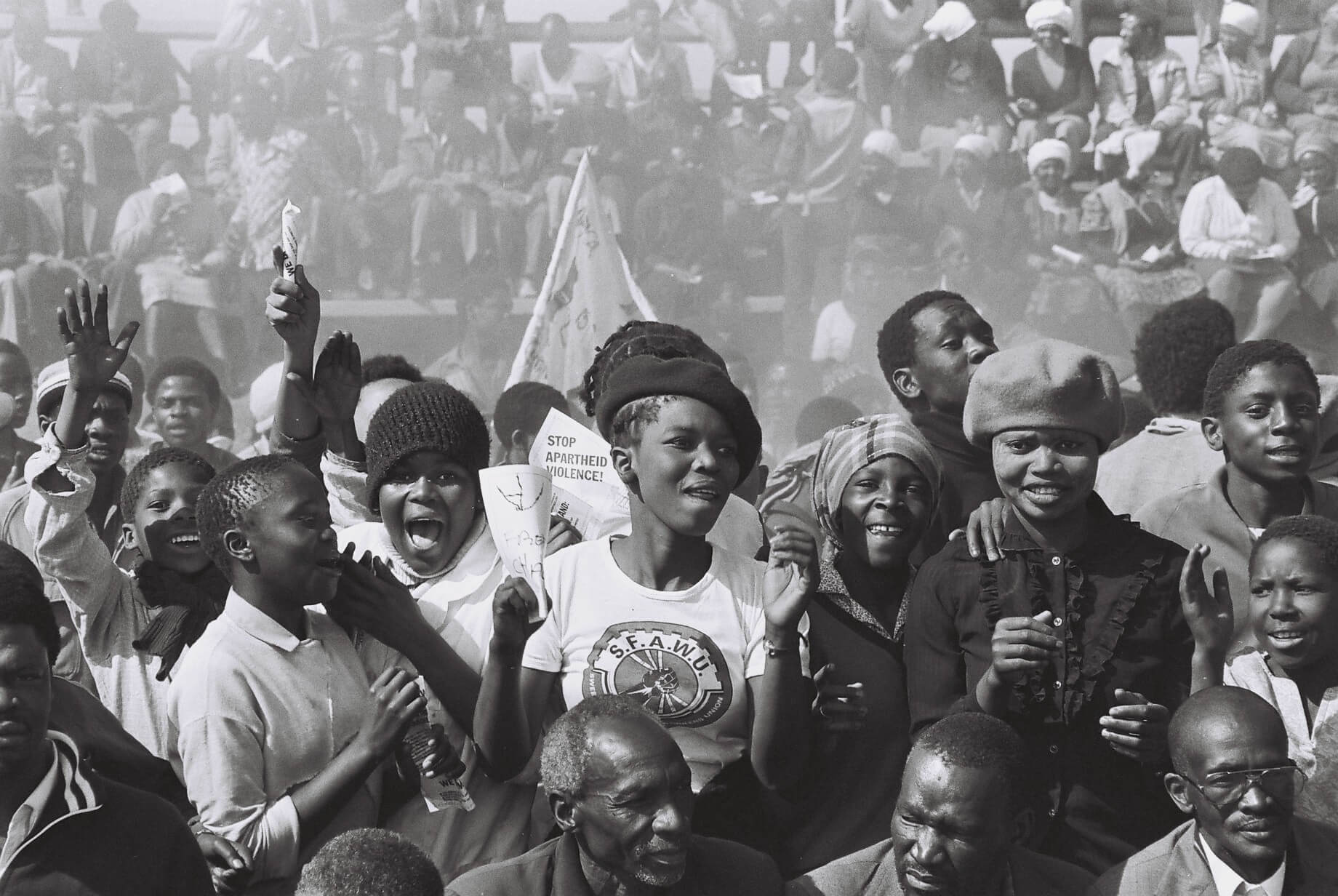
Indeed, when one looks at the South Africa of today, ten years after the death of Steve Biko, the need for this book becomes all the more apparent. It is a time of rising tensions, unrelenting anger and increased polarization. Tens of thousands of people are detained, many of them for over a year. Many too are children – eight, nine, ten years olds who have been at once traumatized and embittered by an experience that humbles even adults. Protest against detention without trial has been declared a criminal act in an extraordinary display of unfounded callousness. White South Africans have blightly indulged in the luxury of an election which reasserts and reaffirms the inequitable and racist nature of South African society. Through a massive strike action blacks have voted as well, expressing their fundamental dissatisfaction, and displaying their inherent and overwhelming potential for economic and political disruption.
As black South Africans confront this new political environment, they do so without the assistance of most of their principal political architects many of whom are incarcerated or have been forced to flee the country. Leaders such as Nelson Mandela, Zephania Mothopeng, Walter Sisulu and Govan Mbeki are in jail, the African National Congress and the Pan Africanist Congress are proscribed, and Oliver Tambo, Johnson Mlambo and Mosibudi Mangena are in exile. Those that remain above board and active are under tremendous pressure to provide the proper physical and moral authority to a struggle shorn of its leadership. Understandably, they have not the time to engage in the important task of furnishing intellectual guidance and direction. Thus, a decade after his death, what Steve Biko had to say then is critical in preserving and advancing the struggle of which he is no longer a part.
____________
To some degree the life and death of Steve Biko epitomize the age-old question of whether the man creates the times or the times creates the man. In the case of Biko, there is no answer to the riddle but it can be said with the greatest of assurance that he was a man of his times, perhaps THE man of his times.
In retrospect, he seemingly burst upon a nation unprepared for his daring, his genius, his succinct understanding of the nature of the political process. His emergence as a bold, calculating, astute political operative jolted whites unaccustomed to a black man with such an acute sense of comfortable assertiveness. Here was a man who tweaked their noses intellectually, laughed at their displeasure and had the audacity to recognize his superiority. His was the vitality of youth that compelled him to regard with disdain any attempt to minimize his dignity or the dignity of black people. In short, he was the prototype of the black nation to come.
Biko’s lasting legacy was that he had an uncomplicated vision; an intrinsic appreciation of the essence of the struggle confronting black people. He used that perception to place the problems of black people into a broader context making possible the next stage of black protest. His contribution was that he bridged the difference between resistance and apathy. Like Robert Sobukwe, he was the necessary intellectual link that makes and sustains a revolution. He was, and is, the catalyst that binds the ANC and PAC with South Africa’s black youths and forging a link between the defiance of the past and the determination of the present.
What Biko was able to do was to create an environment that in and of itself promoted a process of change. The central tenet of Biko’s thought was the need to mobilize and conscientise a nation for political action. As a consequence, he charted a course that forced white South Africa beyond its equilibrial limits, and coerced the country into confronting its political realities. And yet, despite the audacity of his approach, at no point did Biko doubt the capacity of black South Africa to prevail. The strength of that conviction created a starling vision of what was possible in South Africa – what should be in South Africa: an appreciation of the fullness of human dignity. Freedom is impossible without a concept of liberation; a revolution is impossible without an ideology. Black Consciousness, Biko’s most significant contribution, provided a framework for political emancipation.
____________
There comes a time in any struggle for liberation when a moment crystallises and the reality of change becomes clear to oppressor and oppressed alike. In the psychology of struggle, that moment is often just a glimmer; a subtle shifting in momentum that is virtually imperceptible except to those locked in the intensity of survival. A struggle – any struggle political or otherwise – is about the process of controlling fear. For the oppressor, fear is the weapon that permits subjugation; for the oppressed, fear is what makes repression possible.
Of oppressor and oppressed, whichever is best able to overcome the paralytic essence of fear, will ultimately triumph in the struggle between the two. Because oppression demands the acquiescence of the oppressed, and because that acquiescence can never be totally assured, those with power are conflicted with their need to suppress their own uncertainties and insecurities in an effort to maintain control. Thus, when the Moment of Realization occurs, it shoots a dart of unimaginable fear in the heart of the oppressor, convulsing the psychic and setting in motion the chain of events that leads to the inevitable demise.
The moment often appears far more sharply in retrospect, than at the time of its occurrence. The need of the oppressor to come to grips with its own fear cauterises its existence, and unleashes a barrage of frenzied thrashings in an effort to exorcise the numbing sense of dread. It is a time of great violence as the oppressor seeks to purge the same fear that has for so long plagued the oppressed. The realization that control has been lost is a seed that grows with time, and because it takes time, its early growth often goes unnoticed. Such is not the case for the oppressed. The Moment of Realization is a cataclysmic psychological breakthrough filling the oppressed with a sureness and vigour that overcomes its lack of power and cleanses away the remnants of fear.
It is perhaps too early to reflect on South Africa’s current history – too much is happening; too much is still to happen before one can rationalize the past. But already the Moment that shaped South Africa’s soon to be future is sketched indelibly in the minds, hearts and souls of black South Africa. The Moment occurred on the sixteenth of June 1976 when thirteen-year old Hector Petersen became the first casualty of the Soweto uprisings. Hector Petersen’s death, and the death of hundreds of others that followed, liberated blacks from fear and became the symbol of black resistance. For blacks, the realization was that death only terminated the body it did not extinguish the spirit, the movement, the purpose of life. The freedom from fear was Biko’s most substantial contribution to the Moment. Without it, it is questionable whether such a Moment would have ever occurred. “The lack of fear is a very important determinant in political action,” he had once said. On another occasion he wrote, “We must remove from our vocabulary completely the concept of fear.” Biko did not merely articulate the need for a lack of fear; he was himself the physical embodiment of fearlessness. “To understand me correctly,” he noted, “you have to say that there were no fears expressed.” Because of what he characterized not surprisingly, fifteen months after Hector Petersen was killed, Steve Biko died brutally while detained under South Africa’s notorious security laws. “You are either alive and proud or you are dead you can’t care anyway.” Physically, Steve Biko was gone; psychologically he was everywhere.
____________
Given the current State of Repression, it would be understandable if black South Africa were discouraged or disoriented by recent events. The violent crackdown, the continuing detentions, and the attempt at political intimidation all challenge the ability of the black community to sustain its commitment to fundamental and irrevocable change. For the moment, it would appear as if those in power have gained the upper hand and have finally been able to stem the momentum gained by three years of spirited resistance by school children, rent boycotters, labourers and activists.
Yet for however much the state strives for the appearance of normality and control, the South Africa of the past is no more. Paradoxically, the resurgence of the white right wing and hard-line politics rather than being proof of the government’s superiority are but graphic indications of how far and how fast blacks have been able to move the political parameters. This is not to suggest that the movement for change will not have its setbacks. The oppression that is, and will be visited upon the black community will cut deep into the core of its strength, wrecking havoc on families and organizations alike. This will be a period of disheartening confusion, political fragmentation and displaced anger. It will be a period that questions political resolve and tests strategies and tactics.
In light of what is presently occurring in South Africa, it is sometimes easy to forget that protest and defiance have been the hallmark of black politics since the founding of the African National Congress in 1912. The current unrest that grips the country is nothing more than the continuation of a struggle that is nearly seventy-five years old. More importantly, the crackdown that followed Sharpeville and South Africa’s first state of emergency in 1960, and the systematic repression that has come to characterize present-day South Africa, welded together three generations of black people united in their opposition to apartheid.
The generation of the fifties and sixties were the early pioneers of protest. Their children, the generation of the sixties and seventies furthered political consciousness, and now their grandchildren, the generation of the seventies and eighties, are on the cutting edge of a struggle for political liberation.
Indeed, the experience of the past thirty years has politicised a younger, more militant generation determined to battle the government from the townships rather than taking up the struggle abroad. The implications of a restless generation willing to fearlessly take on South African authority from inside are profound. It suggests that in combination with external forces, over time, a meaningful two-pronged revolutionary initiative can be pursued.
Moreover, the townships themselves are incubators of unrest. School boycotts, rent boycotts, bus boycotts, consumer boycotts, labour unrest, child detentions and police assures that no family remains untouched by political developments. A labourer comes home from a day of unrest at his factory to meet his wife who is home following boycotts at the ships and they are joined by their children who are home from boycotting classes. The home itself is no sanctuary because there is a rent boycott that must be dealt with, and lurking in everyone’s mind is the possibility of a raid by the security police. The townships are a cesspool of festering militancy.
But it is the fate of the children that looms most ominously. Many have not attended classes in years; are unable to find employment; and have a limited means of mobility. While the closure of schools has meant that they are no longer being educated, it has also meant that they are no longer exposed to the subtle social and political conditioning that school provides. It has meant an uninhibited, reckless child whose only education is violence and repression. More frightfully, the children are becoming younger, more harden, more bitter and increasingly the foot soldiers for the struggle to come.
What this suggests, is that the townships have become all but inaccessible to the government except through the massive infusion of police or military forces. The fact that blacks now control the townships is an achievement of great significance. While it is not thought of in conscious terms, from the black perspective, it is one victory in a long and continuing struggle. In the short and medium term, despite disruptive measures by the state, efforts will be made to consolidate the gain and to deal with internal fragmentation. The ungovernability of the townships has now become a permanent feature in the South African equation. Black politics have changed irrevocably. It has moved in stages from resistance to protest to defiance, and is now moving from insurgency to revolution. Indeed, any serious consideration of the future of South Africa must of necessity focus on black politics and emerging political developments that have brought the country to the verge of the abyss.
Despite the build-up of revolutionary manifestations in South Africa, a revolution can only occur when various rebellious incidents reveal the inherent weakness of the government to maintain its monopoly on power. In short, a revolution will come about in South Africa when blacks achieve the ability to force a revolution and whites lose the ability to prevent one. It is at the confluence of those two elements at which a revolution becomes possible.
Yet unquestionably, at the heart of a revolution is the people themselves. It is only until a substantial portion of the population becomes politically involved and actively supports the revolutionary forces will a revolution be possible. Mass discontent is the single-most crucial element in the making of a revolution. That disposition makes people responsive to revolutionary leadership and receptive to the idea of a revolutionary solution.
The idea of a revolutionary solution is inherent in Biko’s ideas. He continually voiced and explained the itching discontentment that all blacks felt about their situation in South Africa. He did so in a way that provided a focus and direction for political action. His accomplishment was to constructively channel black rage into a purposeful vehicle for black liberation. His death was the ultimate sacrifice in achieving those objectives.
____________
Death comes easily in South Africa for those who are black. Often it is a stealing death that creeps into their lives robbing them of the essential human dignity needed to survive. All too frequently, all too painfully, it is a searingly violent death, as lives are erased as if they were so many unnecessary mistakes. In South Africa where death is so common, Biko stands out as a martyr, for martyrs are a necessary prerequisite for any sustained struggle for political emancipation.
In the end, it is death that becomes the final arbiter of life, the judge of one’s legacy. It is only with death the impact and significance of an individual’s life is understood. It is, therefore, a measure of the degree in which he is still held that a decade after his death, Steve Biko is alive and well in the collective mind of Black South Africa. He is alive because the struggle for which he gave his life continues. Today, in the dusty, sulphur-choked streets of South Africa’s townships, his legacy is the unspoken current that drives a fledgling revolution aimed at dismantling a system of repression. As black South Africans grapple with a regime determined to dictate the pace and direction of political participation, a realization has occurred in which blacks now know that repression is only possible when those who would be repressed resign themselves to its inevitability. Emancipation, on the other hand, is only possible when those who would be free accept the inevitability of their liberation. This, ultimately is the message of Bantu Steve Biko.